

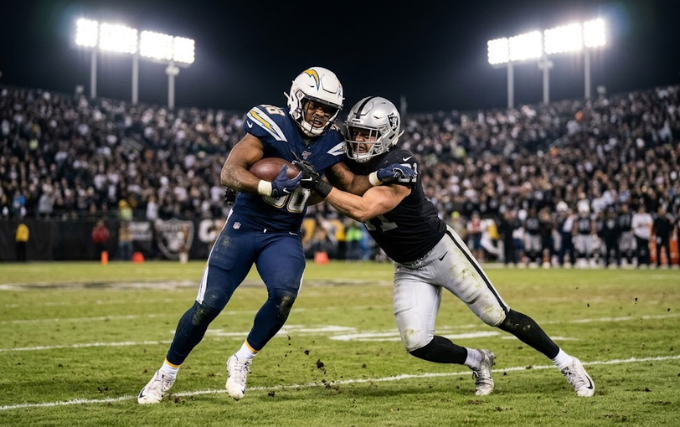
The Los Angeles Chargers vs Las Vegas Raiders match player stats provide a detailed look at how individual players performed during one of the NFL’s AFC West rivalry games. The most recent completed meeting between these teams took place on November 30, 2025, at SoFi Stadium in Inglewood, California. The Chargers won 31-14 and completed a season sweep over the Raiders.
Los Angeles controlled the game through a strong rushing attack, efficient third-down execution, and several important offensive plays. Meanwhile, Las Vegas struggled to create consistent production on the ground. Even though the Raiders found the end zone twice, the Chargers built enough separation after halftime to secure a comfortable victory.
Match Overview
The Chargers entered the game after a bye week, while the Raiders looked to turn their season around. Los Angeles eventually established control and finished with a 31-14 victory.
Justin Herbert completed 15 of 20 passes for 151 yards, two touchdowns, and one interception. He also played through a left-hand injury that he suffered early in the contest.
Kimani Vidal produced one of the most impressive performances of the afternoon. He carried the ball 25 times for 126 yards and scored a 59-yard touchdown. Jaret Patterson also added 54 rushing yards and a touchdown on 11 carries. Together, the Chargers finished with 192 rushing yards.
For Las Vegas, Geno Smith completed 18 of 23 passes for 165 yards, two touchdowns, and one interception. Brock Bowers caught four passes for 63 yards and scored both Raiders touchdowns.
Justin Herbert Player Stats
Justin Herbert remained one of the central figures in the matchup. Despite dealing with a hand injury, he completed 15 of his 20 passing attempts.
His final passing numbers included:
- Completions: 15
- Attempts: 20
- Passing yards: 151
- Passing touchdowns: 2
- Interceptions: 1
- Rushing: 4 carries for 21 yards
Herbert connected with Quentin Johnston for the opening touchdown and later found Ladd McConkey for another score. His passing numbers did not reach the huge totals that sometimes appear in Chargers games, but he made several important throws when Los Angeles needed to move the chains.
Furthermore, Herbert helped the Chargers maintain possession and supported an offense that repeatedly converted third downs. His ability to continue playing after the hand injury also became an important part of the game’s story.
Kimani Vidal Leads the Chargers’ Rushing Attack
Kimani Vidal delivered the biggest statistical performance among the Chargers’ running backs.
He finished with:
- 25 carries
- 126 rushing yards
- 5.0 yards per carry
- 1 rushing touchdown
- Longest run: 59 yards
Vidal broke through the Raiders’ defense early in the third quarter and turned a short-field situation into a 59-yard touchdown. That play gave Los Angeles a 14-7 lead and changed the momentum after the teams entered halftime tied at 7-7.
The Chargers continued using Vidal throughout the game. His workload helped Los Angeles control the clock and reduce pressure on Herbert.
With Omarion Hampton unavailable for the matchup, Vidal received an expanded role. He took advantage of that opportunity and recorded a career-high 126 rushing yards.
Jaret Patterson Adds Another Rushing Threat
Jaret Patterson also played an important role for Los Angeles. He carried the ball 11 times for 54 yards and scored a touchdown late in the fourth quarter.
His production gave the Chargers another reliable option in the running game. As a result, Los Angeles could continue attacking on the ground even after Vidal had already produced a major performance.
The Chargers finished with 43 rushing attempts for 192 yards and two rushing touchdowns. That balance helped them control the second half.
Chargers Receiving Player Stats
Although the Chargers leaned heavily on their running game, several receivers made important contributions.
Quentin Johnston
Quentin Johnston caught the game’s opening touchdown pass from Herbert. His 10-yard reception gave Los Angeles an early 7-0 advantage.
Johnston entered the matchup after already making a strong impact earlier in the 2025 season. Against Las Vegas, he again provided an important red-zone target.
Ladd McConkey
Ladd McConkey caught four passes for 39 yards and scored a touchdown. His seven-yard touchdown reception came late in the third quarter and increased the Chargers’ advantage to 21-7.
McConkey’s touchdown helped Los Angeles build separation after Vidal’s long scoring run.
Keenan Allen
Keenan Allen also contributed four receptions for 30 yards. While his yardage total remained modest, his experience gave Herbert another dependable option in the passing game.
Geno Smith Player Stats
Geno Smith handled the majority of the Raiders’ passing work. He completed 18 of 23 attempts for 165 yards, two touchdowns, and one interception.
Smith completed a high percentage of his throws, but the Raiders struggled to turn those completions into sustained offensive drives. Their rushing attack produced only 31 yards, which placed additional pressure on the passing game.
Smith’s two touchdown passes both went to Brock Bowers. However, the Chargers’ defense limited the Raiders to 156 total offensive yards, making it difficult for Las Vegas to keep pace.
Brock Bowers Leads Raiders Receivers
Brock Bowers produced the strongest receiving performance for Las Vegas.
His final numbers were:
- Receptions: 4
- Receiving yards: 63
- Receiving touchdowns: 2
Bowers caught his first touchdown on a six-yard pass from Smith late in the second quarter. That score tied the game at 7-7.
Later, Bowers found the end zone again on another six-yard reception during the fourth quarter. His second touchdown reduced the Chargers’ advantage to 24-14 and briefly gave Las Vegas an opportunity to make the game closer.
Despite his strong individual production, the Raiders could not generate enough offense around him.
Raiders Rushing Player Stats
Las Vegas struggled considerably on the ground.
The Raiders ran the ball 18 times for only 31 yards, averaging roughly 1.7 yards per attempt.
Ashton Jeanty carried the ball 13 times for 29 yards. His limited rushing production prevented the Raiders from establishing a consistent ground game.
That problem became more significant as the Chargers built their lead. Because Las Vegas could not consistently gain yards on early downs, the offense faced difficult situations and struggled to sustain drives.
Chargers Defensive Player Stats
The Chargers’ defense played an important role in limiting Las Vegas.
Los Angeles consistently pressured Geno Smith and restricted the Raiders’ running game. Tuli Tuipulotu recorded two sacks, while the Chargers also generated pressure from several other defenders.
The defense benefited from the offense’s ability to control possession. Once the Chargers established their running game, Las Vegas had fewer opportunities to dictate the pace.
The Chargers also finished the game with a significant advantage in total offensive production. Their balanced attack allowed the defense to spend more time playing with a lead.
Raiders Defensive Player Stats
The Raiders had several notable defensive contributors despite the loss.
Maxx Crosby remained a major presence on the defensive line. He recorded two sacks of Herbert during the game, showing his ability to create pressure even when Los Angeles maintained control.
Kyu Blu Kelly also made an important play when he intercepted Herbert in the second quarter. That turnover prevented the Chargers from adding points during a promising drive.
However, the Raiders’ defense eventually struggled to contain the Chargers’ rushing attack. Vidal’s 59-yard touchdown run highlighted the difficulty Las Vegas faced in stopping Los Angeles after halftime.
Team Statistics
The overall numbers show why the Chargers controlled the matchup.
| Statistic | Chargers | Raiders |
| Final score | 31 | 14 |
| Rushing yards | 192 | 31 |
| Rushing attempts | 43 | 18 |
| Passing yards | 151 | 165 |
| Total offensive yards | 343 | 156 |
| Passing TDs | 2 | 2 |
| Rushing TDs | 2 | 0 |
The biggest difference came on the ground. Los Angeles generated 192 rushing yards, while Las Vegas managed only 31. That 161-yard difference gave the Chargers a major advantage in controlling the game.
Third-down efficiency also favored Los Angeles. The Chargers converted 12 of 17 third-down opportunities, while the Raiders converted only 2 of 8. That gap allowed the Chargers to extend drives and keep their offense on the field.
How the Game Developed
The Chargers opened the scoring when Herbert connected with Johnston for a 10-yard touchdown. Las Vegas responded in the second quarter when Smith found Bowers for a six-yard score.
The game remained tied at halftime, but Los Angeles quickly changed the momentum after the break.
Vidal exploded for a 59-yard touchdown on the third play of the second half. Later in the quarter, Herbert connected with McConkey for another touchdown. Those two scoring plays gave Los Angeles a 21-7 advantage.
Cameron Dicker then added a 56-yard field goal early in the fourth quarter. Bowers responded with his second touchdown, but Patterson later scored on a two-yard run to close out the Chargers’ 31-14 victory.
What the Player Stats Show
The Los Angeles Chargers vs Las Vegas Raiders match player stats reveal a clear contrast between the two offenses.
Los Angeles relied on a powerful rushing attack, with Vidal leading the way. Herbert complemented that ground production with two touchdown passes despite playing through a hand injury.
Las Vegas received efficient quarterback play from Smith and excellent red-zone production from Bowers. However, the Raiders could not establish their running game, and that limitation affected their ability to sustain drives.
Meanwhile, the Chargers converted third downs at a much higher rate and consistently moved the chains. Their offensive line and running backs helped control the second half, while the defense prevented the Raiders from mounting a sustained comeback.
Conclusion
The November 30, 2025 meeting provides a useful example of how individual player performances can shape an NFL rivalry game. Kimani Vidal supplied the explosive rushing performance, Justin Herbert delivered two touchdown passes, and Ladd McConkey and Quentin Johnston contributed receiving touchdowns.
For Las Vegas, Brock Bowers stood out with two touchdown receptions, while Geno Smith completed 18 of 23 passes. Nevertheless, the Raiders’ limited rushing production made it difficult for the offense to keep pace.
Ultimately, Los Angeles finished with a 31-14 victory and completed the 2025 regular-season sweep of Las Vegas. The player statistics show that the Chargers’ success came primarily from their rushing efficiency, third-down execution, and ability to create separation after halftime.
