

Let’s say you are traveling down a crowded road. A traffic light turns red in front of you. You are aware that you have to stop if the light turns red. You use this rule in the given circumstance. You bring the vehicle to a stop. The essence of the law of detachment in logic is this process of applying a general rule to a particular situation.
This logical rule provides a simple method for drawing a conclusion. It serves as a tool for deductive reasoning, which proceeds from broad assertions to particular conclusions. The central concept is around a particular kind of statement called a conditional, or “if-then” statement.
The Core Principle: A Simple Logical Formula
The basic idea behind the system’s operation is straightforward. There are two components to every conditional statement. The “if” clause, which logicians refer to as the antecedent or hypothesis, is the first section. The “then” sentence, often known as the consequent or conclusion, makes up the second section.
The law offers a precise framework for transitioning from a general rule to a particular, assured result. There are three phases in this structure.
A correct conditional statement is a prerequisite. This can be expressed as “If P, then Q.” “P” stands for the hypothesis, and “Q” for the conclusion.
Secondly, you need a true statement that verifies that the hypothesis “P” is true in a particular instance.
Lastly, you may separate the conclusion because both the specific fact and the general rule are true. In that particular instance, you can deduce that “Q” is likewise true. This last stage of isolating the conclusion from the conditional in order to apply it directly is reflected in the term “detachment”.
The Law in Action: A Closer Look
To clarify this, let’s look at a specific scenario. The following is true: “If a figure is a square, then it has four sides.” A second true statement is now added: “This figure is a square.” By combining these two facts, the law of detachment enables us to draw the conclusion that “This figure has four sides.”
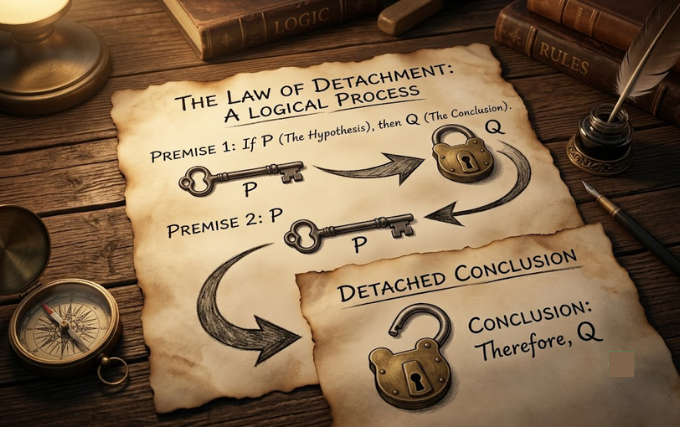
To show the logical framework of this procedure, it is frequently expressed in a straightforward, abbreviated form.
Premise 1: If P, then Q.
Premise 2: P.
Conclusion: Therefore, Q .
This pattern needs to be exact. The second statement ought to precisely reflect the first’s supposition. Knowing merely that “This figure has four sides,” we are unable to determine that it is a square. The law is not reversible. It would be incorrect to assume that a shape with four corners is a square. Additionally, the conditional statement needs to be a “if-then” statement. The law cannot be applied to unrelated facts such as “The sky is blue” and “My dog is a beagle.” The required structure is absent from these two facts.
Recognizing Valid and Invalid Applications
This law’s strength is found in its capacity to produce complete certainty. The conclusion must be unquestionably true if the first claims are. Because of its certainty, it is a fundamental component of scientific reasoning and mathematical proofs, where each stage must be built upon an unwavering base.
This pattern is also present in many commonplace circumstances. See how it works by looking at these samples.
The grass is damp if it’s raining. It’s pouring. The grass is damp as a result.
A person who works as a teacher is employed by a school. Maria works as a teacher. Maria is employed at a school as a result.
A number is divisible by two if it is even. Eight is an even number. Eight is therefore divisible by two.
Now think about a few situations in which the law is not applicable. This makes its stringent criteria more clear.
Case 1: The grass is wet if it’s raining. The grass is damp. In conclusion, it’s pouring. This is not valid. The grass may be damp from morning dew or a sprinkler.
Case 2: A person is a citizen of the United States if they reside in New York. John is an American citizen. In conclusion, John resides in New York. This is not valid. He might reside in Texas or California.
Case 3: Every dog is an animal. Every cat is an animal. In conclusion, all dogs are cats. There is no conditional statement to work with, therefore this is clearly invalid.
Every faulty example demonstrates a frequent error. Affirming the consequent, which implies that the “then” part ensures the “if” part, is one error. Denying the antecedent is another, which implies that if the “if” section is wrong, then the “then” part must also be false. These mistakes are prevented by the law of detachment, which rigorously transitions from a verified “if” to a specific “then.”
The Principles Behind the Logic
The logic of the law is based on a number of fundamental ideas. The idea of a conditional statement comes first. The veracity of the hypothesis is absolutely necessary for the conclusion to be true. “If P, then Q” does not imply that “P” is true. It merely creates a connection between them. The second premise supplies the crucial “P.”
The character of deductive validity is the second premise. The most basic type of deductive reasoning is the law of detachment. When the premises are true, the conclusion of a logical argument must also be true. This kind of legitimacy is guaranteed by the law.
The distinction between truth and validity is the third principle. In the real world, a conclusion does not always follow from a sound logical structure. The end result is only as trustworthy as the original facts, even though the method is perfect. We can nonetheless arrive to a legitimate but incorrect conclusion if we begin with wrong premises.
Take this argument, for example: The sun is beaming if it is snowing. It’s snowing. The sun is shining as a result. This exactly adheres to the logical pattern. But since the first claim is untrue, the reasoning is flawed. The premise is untrue, but the reasoning is sound. This emphasizes the importance of constantly verifying the accuracy of your initial facts.
Distinguishing the Law from Other Logical Tools
This rule belongs to a group of logical instruments. It is crucial to distinguish it from the law of syllogism, another prevalent rule. Two conditional assertions can be connected using the law of syllogism. You can infer “If P, then R” if you know “If P, then Q” and “If Q, then R.” A particular fact must be entered into the hypothesis in order to apply the law of detachment. By combining two preexisting rules, the law of syllogism establishes a new norm.
Additionally, more intricate proofs are built upon the law of separation. In geometry, mathematicians utilize it to demonstrate the characteristics of shapes. It is used by scientists to make predictions. They can conclude that the prediction will occur if their theory (the conditional statement) is accurate and the experiment supports the hypothesis. These logical processes are made possible by the confidence that the law provides.
Conclusion
A basic law of logic that controls the transition from a general principle to a particular fact is the law of detachment. It enables us to derive conclusions from true conditional statements and their valid hypotheses that cannot be refuted. It’s an easy and effective approach. Understanding the “if-then” structure, determining the hypothesis in a particular situation, and then “detaching” the conclusion to apply it are all necessary. The logic is perfect, yet it relies on the premises’ absolute veracity. The law is a crucial instrument for science, math, and logical thinking in all spheres of life because of its straightforward, rule-based methodology.
