

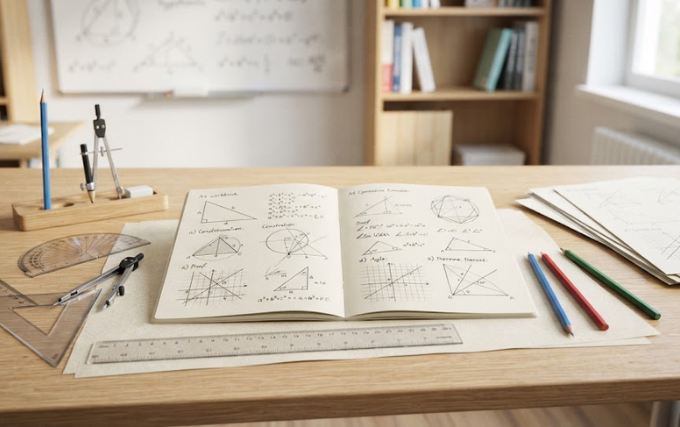
Geometry can look difficult at first, especially when students encounter unfamiliar shapes, formulas, angles, and diagrams. However, a clear learning system can make these topics much easier to understand. Geometry Learn V3 offers a useful way to approach geometry through organized lessons, practical examples, and regular problem-solving.
For students who want to improve their mathematical thinking, geometry provides more than formulas. It teaches learners how to examine shapes, compare measurements, understand space, and solve problems step by step. As a result, learning geometry can also strengthen logical thinking and attention to detail.
This guide explains what Geometry Learn V3 means, what students can learn from it, how to approach geometry topics, and which study habits can produce better results.
What Is Geometry Learn V3?
Geometry Learn V3 refers to a version or approach designed to help students study geometry in a structured way. The name suggests an updated learning experience that focuses on making geometry topics easier to follow.
Rather than trying to memorize every formula at once, students can build their understanding gradually. They can start with basic shapes and measurements before moving toward more advanced concepts such as theorems, coordinate geometry, transformations, and geometric proofs.
A structured learning approach also helps students recognize connections between different topics. For example, understanding angles can help with triangles, while triangle knowledge can support work with polygons and circles.
Therefore, students should treat Geometry Learn V3 as a learning process rather than simply a collection of formulas.
Why Do Students Need Geometry?
Geometry appears in many areas of mathematics and everyday life. Architects use geometric measurements when planning buildings. Engineers work with shapes, angles, distances, and dimensions. Designers rely on geometry when creating layouts, objects, and visual elements.
Even outside technical careers, geometry develops useful thinking skills. Students learn how to examine information carefully and reach conclusions through logical steps.
For instance, a geometry problem may provide the length of two sides and an angle. Instead of guessing the answer, a student needs to identify the correct relationship and apply the appropriate method.
Consequently, geometry can improve both mathematical confidence and problem-solving ability.
Understanding Basic Geometric Shapes
A strong geometry foundation starts with basic shapes. Students should become comfortable identifying common figures before moving into more complicated problems.
A point represents an exact position. A line extends indefinitely in both directions, while a line segment has two endpoints. A ray starts at one point and continues in one direction.
Students also encounter several common two-dimensional shapes:
- Triangle
- Square
- Rectangle
- Parallelogram
- Rhombus
- Trapezoid
- Pentagon
- Hexagon
- Circle
Each shape has different properties. A square, for example, has four equal sides and four right angles. A rectangle also has four right angles, but opposite sides have equal lengths.
Learning these differences makes later problems much easier.
Learning Angles
Angles form another important part of geometry. An angle measures the amount of rotation between two rays that meet at a common point.
Students commonly work with several types of angles. An acute angle measures less than 90 degrees. A right angle measures exactly 90 degrees. An obtuse angle measures more than 90 degrees but less than 180 degrees. A straight angle measures 180 degrees.
Geometry Learn V3 can help students approach these concepts step by step. Instead of memorizing names alone, learners should draw examples and compare their measurements.
Additionally, students should learn relationships between angles. Complementary angles add up to 90 degrees, while supplementary angles add up to 180 degrees.
These relationships often appear in school exercises and examination questions.
Understanding Triangles
Triangles play a major role in geometry. Every triangle has three sides, three vertices, and three interior angles. The interior angles always add up to 180 degrees.
Students can classify triangles according to their sides. An equilateral triangle has three equal sides. An isosceles triangle has two equal sides. A scalene triangle has three different side lengths.
They can also classify triangles according to their angles. A triangle may contain acute angles, one right angle, or one obtuse angle.
Once students understand these categories, they can solve many triangle problems more confidently.
The Pythagorean theorem also plays an important role when students study right triangles. It connects the lengths of the two shorter sides with the hypotenuse. Students can use this relationship to find an unknown side when they know the other two measurements.
Exploring Circles
Circles introduce another important group of geometric concepts. Students should understand terms such as radius, diameter, circumference, and area.
The radius measures the distance from the center of a circle to its edge. The diameter crosses the circle through its center and measures twice the radius.
Students often use formulas for circumference and area when solving circle problems. However, understanding what each measurement represents matters just as much as remembering the formula.
Drawing circles and labeling their parts can make these concepts easier to remember. Furthermore, practical examples can connect the lesson to familiar objects such as wheels, clocks, plates, and circular signs.
Perimeter and Area
Perimeter and area often confuse beginners because both involve measurements but describe different things.
Perimeter measures the distance around a shape. Area measures the amount of space inside that shape.
For a rectangle, students can calculate the perimeter by adding all four sides. They can calculate the area by multiplying the length by the width.
These ideas become especially useful when students work with irregular shapes or real-world problems. For example, someone might need to calculate the amount of fencing required around a garden. That problem requires perimeter rather than area.
On the other hand, calculating how much flooring a room needs requires area.
Understanding the difference helps students choose the correct method instead of simply searching for a familiar formula.
Coordinate Geometry
Coordinate geometry connects geometry with numbers and graphs. Students work with points on a coordinate plane and use ordered pairs to describe their positions.
The horizontal axis usually represents the x-coordinate, while the vertical axis represents the y-coordinate. A point such as (3, 5) tells the student how far to move along each axis.
With more practice, students can calculate distances between points, identify midpoints, and examine lines.
This topic can seem challenging at first. Nevertheless, students can make progress by drawing every problem carefully and labeling important points.
Geometric Transformations
Transformations show how a shape can change its position or orientation. Common transformations include translation, rotation, reflection, and dilation.
A translation moves a shape without changing its size or orientation. A rotation turns a shape around a specific point. A reflection creates a mirror image. A dilation changes the size while maintaining the overall shape.
These concepts appear in mathematics, design, computer graphics, architecture, and other fields.
Students can understand transformations more easily when they draw the original figure and the new figure together. Visual practice often makes these ideas much clearer than memorizing definitions.
The Importance of Geometric Proofs
Advanced geometry often asks students to explain why a mathematical statement works. This process leads to geometric proofs.
A proof uses logical statements to demonstrate that a conclusion follows from known information. Students may work with definitions, properties, postulates, and theorems.
At first, proofs can feel intimidating. However, students can approach them by identifying the information they already know and then determining what they need to prove.
Writing one step at a time makes the process manageable. Moreover, understanding the reason behind each step matters more than memorizing a complete proof.
How to Study With Geometry Learn V3
Students can get better results when they follow a consistent study routine.
First, learn the basic vocabulary. Geometry contains many terms, and understanding those terms makes questions easier to interpret.
Next, study one concept at a time. Moving from basic angles to advanced proofs without enough practice can create unnecessary confusion.
After learning a concept, solve several problems without immediately checking the answer. This approach helps students discover which parts they understand and which areas need more work.
Drawing diagrams also provides major benefits. Even when a question already includes a diagram, students can redraw it and label the important measurements.
Finally, review mistakes. An incorrect answer can teach students more than an easy question when they take time to understand what went wrong.
Common Challenges Students Face
Many students struggle with geometry because they try to memorize formulas without understanding their purpose. This approach may work for a simple exercise, but unfamiliar questions can quickly cause problems.
Another common issue involves diagrams. Students sometimes overlook labels, assume measurements that the problem never provides, or confuse similar shapes.
Time management can create another challenge. A student may spend too long on one difficult question and leave insufficient time for easier problems.
To overcome these issues, students should slow down during the reading stage. Identify the known information, determine what the question asks, and then select a suitable method.
Tips for Better Geometry Practice
Regular practice usually produces better results than occasional long study sessions. Students can spend a short amount of time each day reviewing formulas, drawing figures, and solving problems.
Here are several practical habits:
- Keep a small formula reference sheet.
- Draw diagrams whenever possible.
- Write down known measurements.
- Circle or underline what the question asks.
- Check units before giving the final answer.
- Review incorrect answers carefully.
- Practice both easy and challenging questions.
- Ask for help when a concept remains unclear.
Additionally, students should avoid rushing through calculations. A small arithmetic mistake can change an otherwise correct solution.
Who Can Benefit From Geometry Learn V3?
Geometry Learn V3 can suit students who want a structured way to approach geometry. Beginners can use basic concepts to build their foundation, while more experienced learners can use practice and review to strengthen their existing knowledge.
Teachers and tutors can also use organized geometry material when preparing lessons or practice activities. Parents may find structured learning resources useful when helping students study at home.
The most important factor, however, remains consistent practice. No learning system can replace active participation from the student.
Conclusion
Geometry becomes much easier when students stop viewing it as a long list of formulas and start seeing the relationships between shapes, measurements, angles, and positions. Geometry Learn V3 provides a useful framework for approaching these concepts in an organized manner.
Students can begin with basic shapes and angles, then gradually move toward triangles, circles, area, perimeter, coordinate geometry, transformations, and proofs. Along the way, regular practice can build confidence and improve problem-solving skills.
Most importantly, students should not become discouraged by difficult questions. Geometry rewards patience and careful thinking. By studying one concept at a time, drawing clear diagrams, checking calculations, and learning from mistakes, learners can make steady progress.
Whether a student prepares for a school examination or simply wants stronger mathematical skills, a structured approach to geometry can make the learning journey more manageable and rewarding.
